Making partner represents a major career milestone. What that title actually means, however, isn’t always the same from one firm to the next. Some firms offer equity partnership, others have non-equity partnership, and many have both. While the distinction may seem straightforward, the differences extend well beyond compensation. Ownership, decision-making authority, business development expectations, financial risk, and long-term career opportunities can all vary depending on the model.
Equity partnership appeals to attorneys who want an ownership stake and are comfortable taking on greater responsibility for the firm’s success. Non-equity partnership can provide leadership opportunities, increased compensation, and professional recognition without the financial commitment or risk of ownership. The sections below break down how each model works, what tradeoffs to consider, and how to think more strategically about the partnership path that best fits your career.
What Are Equity and Non-Equity Partners?
The word “partner” does not always mean the same thing. In some cases, it means ownership. In others, it reflects seniority, leadership, or a step toward possible ownership later.
An equity partner has an ownership interest in the firm. That usually means sharing in profits, contributing capital, and having a voice in major firm decisions. A non-equity partner has the partner title but does not typically own part of the firm. That role may still come with seniority, client responsibility, and leadership expectations, but it usually involves less financial risk and less control over firm governance.
Evaluating a partnership opportunity? Contact us before making a decision.
Equity vs. Non-Equity Main Differences
The biggest difference between equity and non-equity partnership is ownership, but that difference affects several parts of the role. Equity partners are more directly tied to the business of the firm. Their compensation often depends on profitability, client origination, collections, and the firm’s compensation formula. They may also be expected to contribute capital and take part in major decisions about strategy, hiring, compensation, and growth.
Non-equity partners usually have more predictable compensation, often through salary and bonus structures. They may manage clients, supervise attorneys, or lead matters, but they typically have less voting power and less financial exposure than equity partners.
The practical differences can vary widely. At one firm, a non-equity partner may have meaningful influence and a strong path to equity. At another, the title may function more like a senior attorney role. That is why attorneys should look closely at compensation, governance, expectations, and advancement path before assuming one model is better than the other.
How Law Firms Use Each Model Strategically
Many firms use non-equity partnership to recognize experienced attorneys who have developed strong legal skills and leadership abilities but are not yet ready, or interested, in becoming owners. In other firms, non-equity partnership serves as a proving ground where attorneys demonstrate business development capabilities before being considered for equity.
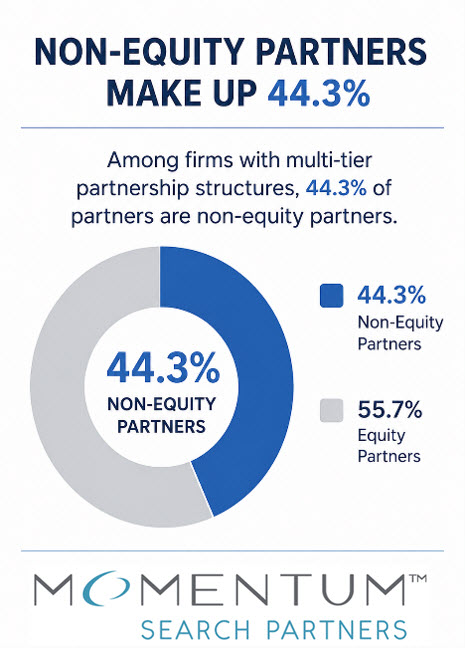
This two-tier approach has become increasingly common throughout the legal industry. According to the National Association for Law Placement, among firms with multi-tier partnership structures, 44.3% of partners are non-equity partners, illustrating how established this model has become across law firms.
The model also gives firms greater flexibility. Not every outstanding attorney wants the responsibilities that come with ownership. Some prefer to focus on practicing law, managing client relationships, or leading practice groups without taking on additional financial obligations.
From the firm’s perspective, multiple partnership tiers also create clearer career progression. Associates can continue advancing professionally without every promotion requiring an ownership decision. That flexibility helps firms retain experienced attorneys while building a stronger leadership pipeline.
Impact on Salary, Benefits, and Total Compensation
Compensation is often the first thing attorneys compare when evaluating partnership opportunities, but the structure behind the compensation can be just as important as the amount.
Non-equity partners typically receive a predictable salary, often supplemented by bonuses tied to billable hours, collections, client development, or firm performance. This structure provides consistency and allows attorneys to plan financially with relatively little year-to-year volatility.
Equity partner compensation works differently. Rather than receiving a fixed salary, many equity partners participate directly in the firm’s profits. Their income can increase significantly during strong years, but it can also fluctuate when firm performance changes. Depending on the firm’s compensation system, earnings may be influenced by client origination, collections, profitability, leadership responsibilities, or a combination of several factors.
The gap between the two models can be substantial. Citing Major, Lindsey & Africa’s 2024 Partner Compensation Survey, Reuters reported that among Am Law 200 partners surveyed, equity partners averaged $1.93 million in income, compared with $558,000 for non-equity partners. While compensation varies by firm size, market, practice area, and individual book of business, the data underscores how significantly ownership status can affect partner compensation.
Higher earning potential naturally comes with greater financial exposure. Equity partners often contribute capital, may have tax obligations that differ from salaried attorneys, and typically shoulder more responsibility for the firm’s financial health. Some attorneys welcome that tradeoff, while others prefer the predictability that comes with a non-equity structure.
When evaluating an offer, it’s also worth looking beyond salary alone. Retirement contributions, health benefits, deferred compensation plans, capital contribution requirements, and bonus formulas can all affect total compensation. Two partnership offers with similar annual income may look very different once those details are considered.
Impact on Governance and Influence
Equity partners generally help shape the firm’s future. They often vote on admitting new partners, approving major expenditures, opening new offices, modifying compensation systems, or making other strategic decisions that affect the business as a whole. For attorneys who enjoy leadership and want a voice in how the firm evolves, that influence can be just as valuable as the financial upside.
Non-equity partners often have leadership opportunities as well, but the scope varies by firm. Many lead practice groups, supervise associates, manage client relationships, or participate on internal committees. Some firms also include non-equity partners in strategic planning discussions, even if formal voting rights remain with equity owners.
The practical impact depends entirely on the firm’s culture. At one firm, a non-equity partner may have considerable influence over operations and client strategy. At another, the role may focus almost exclusively on legal work. For that reason, attorneys considering partnership should ask detailed questions about governance, leadership opportunities, and decision-making authority instead of assuming the title tells the whole story.
Impact on Business Development Expectations
Equity partners are expected to generate new business, expand existing client relationships, and contribute directly to the firm’s long-term revenue growth. Their personal success is closely tied to the firm’s financial performance, so developing a strong client base becomes an important part of the role.
Non-equity partners may also be expected to bring in work, but the pressure is often lower. Some firms emphasize legal excellence over rainmaking for non-equity partners, while others expect every partner to participate in client development regardless of ownership status.
Attorneys considering partnership should ask how client origination is measured, how credit is allocated, and whether compensation is tied directly to business development. Those answers often provide a much clearer picture of daily expectations than the partnership title itself.
Impact on Workload and Work-life Balance
Equity partners frequently spend more time managing the business itself. Their schedules may include firm leadership meetings, recruiting, budgeting, partner committees, strategic planning, and business development in addition to practicing law. Those obligations can extend well beyond billable work.
Non-equity partners often devote more of their time to practicing law and supervising client matters. While the workload can still be demanding, there is generally less responsibility for firm management and ownership decisions. Attorneys who enjoy building a business may find the additional responsibilities rewarding. Others may prefer focusing primarily on clients and legal work without carrying the added weight of ownership.
Equity Model Benefits and Advantages
For attorneys who enjoy building a business, equity partnership offers opportunities that extend well beyond compensation. Ownership provides a direct stake in the firm’s success, allowing partners to share in its profitability while helping shape its future. Equity partners typically have greater influence over strategic decisions, including firm growth, leadership appointments, compensation systems, and long-term planning. Many also enjoy greater autonomy in developing practice areas, managing client relationships, and contributing to the firm’s direction.
While there is more financial risk involved, there is also more opportunity. Attorneys who have built a strong book of business and want to take an active role in firm leadership often find that equity partnership aligns with both their professional ambitions and long-term financial goals.
Non-equity Benefits and Advantages
Non-equity partnership has evolved into much more than a temporary stop on the way to equity. For many attorneys, it represents the ideal balance between professional advancement and financial stability. Rather than investing capital into the firm or taking on ownership responsibilities, non-equity partners can often focus more heavily on practicing law, serving clients, and mentoring younger attorneys. The compensation is generally more predictable, and there is less personal exposure to fluctuations in firm profitability.
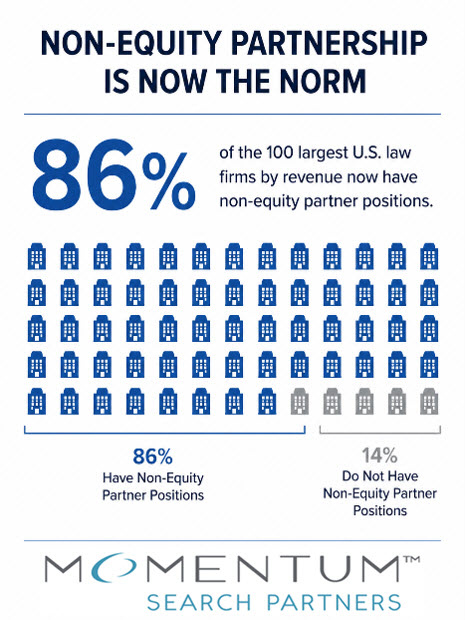
The growing popularity of this model reflects that shift. Reuters reports that 86% of the 100 largest U.S. law firms by revenue now have non-equity partner positions, compared with just 27% of large firms that used multiple partnership tiers three decades ago. That growth suggests firms increasingly recognize that successful attorneys do not all want the same career path.
When Being an Equity Partner Is Good for Your Career
If you’ve developed a strong client base, enjoy business development, and are comfortable making financial investments in your career, ownership can provide both professional influence and significant earning potential. Attorneys who like strategic planning, firm leadership, and mentoring often find those responsibilities rewarding rather than burdensome.
Timing matters as well. Building equity usually makes more sense once you’ve established a stable practice and have confidence in your ability to continue generating work over the long term. Without that foundation, the additional financial risk may outweigh the potential rewards.
When Being a Non-Equity Partner Is Worth It
Not every attorney measures success by ownership. For some, the ability to focus primarily on practicing law is exactly what makes non-equity partnership attractive.
This path often appeals to attorneys who enjoy serving clients, managing complex matters, and leading legal teams without taking on the administrative responsibilities that come with firm ownership. It can also be a good fit for lawyers who value predictable compensation, greater financial stability, or a different work-life balance than equity partnership typically provides.
Non-equity partnership is also worth considering when evaluating a firm’s overall structure. Some firms offer substantial leadership opportunities, excellent compensation, and long-term career growth within their non-equity tier. In those environments, the absence of ownership does not necessarily limit professional fulfillment or advancement.
Rather than asking which partnership model carries more prestige, attorneys should ask which one better supports the kind of career they actually want to build.
A Better Way to Negotiate Partner Compensation
Whether you’re considering an equity or non-equity partnership, compensation discussions should extend well beyond salary. Partnership structures vary significantly from firm to firm, and understanding the full picture often reveals opportunities that aren’t immediately obvious.
Ask questions about how compensation is determined, how bonuses are calculated, whether client origination affects earnings, and what leadership expectations come with the role. If equity is involved, understand the capital contribution requirements, profit distribution model, and how decisions are made about future compensation adjustments. For non-equity opportunities, look beyond base salary to evaluate bonus potential, advancement opportunities, and the firm’s long-term vision for the position.
A partnership offer should support not only your compensation goals but also the kind of practice you want to build over the next five, ten, or twenty years. Momentum Search Partners helps attorneys evaluate partnership opportunities with a clear understanding of today’s legal market. If you’re weighing an equity or non-equity offer, reach out to our team for guidance before you make your next career move.